

The Simple Reason Your Team Isn’t Using AI
If you want people to actually try AI, you have to stop interrupting their workday.

Picture this: It’s 10:14 AM. Your inbox has 47 unread messages. You have three meetings before lunch and a report due by the end of the day.
Somewhere in that stack - sandwiched between a project update and a calendar invite is a company-wide email about a new AI tool. It has a cheerful subject line. Maybe a short video. A few bullet points about what’s possible.
You bookmark it. You tell yourself you’ll come back to it when things slow down.
You don’t come back to it.
This isn’t about employees being distracted. It’s about timing, context, and a mismatch between how we communicate about AI and how humans actually receive information. Organizations often rely on a standard playbook: send an email, mandate the training, and expect change.
But AI is different.
You can’t just mandate curiosity.
The New Bottleneck that Only a Few Notice!
Most organizations have invested seriously in AI tools. Licenses have been purchased, platforms deployed, and training sessions scheduled.
Yet, adoption often remains low.
When organizations survey employees, the response is rarely “we don’t see the value”. It is usually:
“We get it. We want to try it. We just don’t have time”.

When employees say they don’t have time, what they often mean is that the message found them at the wrong moment. A message that arrives during a busy day - no matter how good it is - gets filed away and forgotten. The real bottleneck isn’t resistance; it’s attention. And attention isn’t evenly distributed across our communication channels.
Three Channels. Three Mental States.
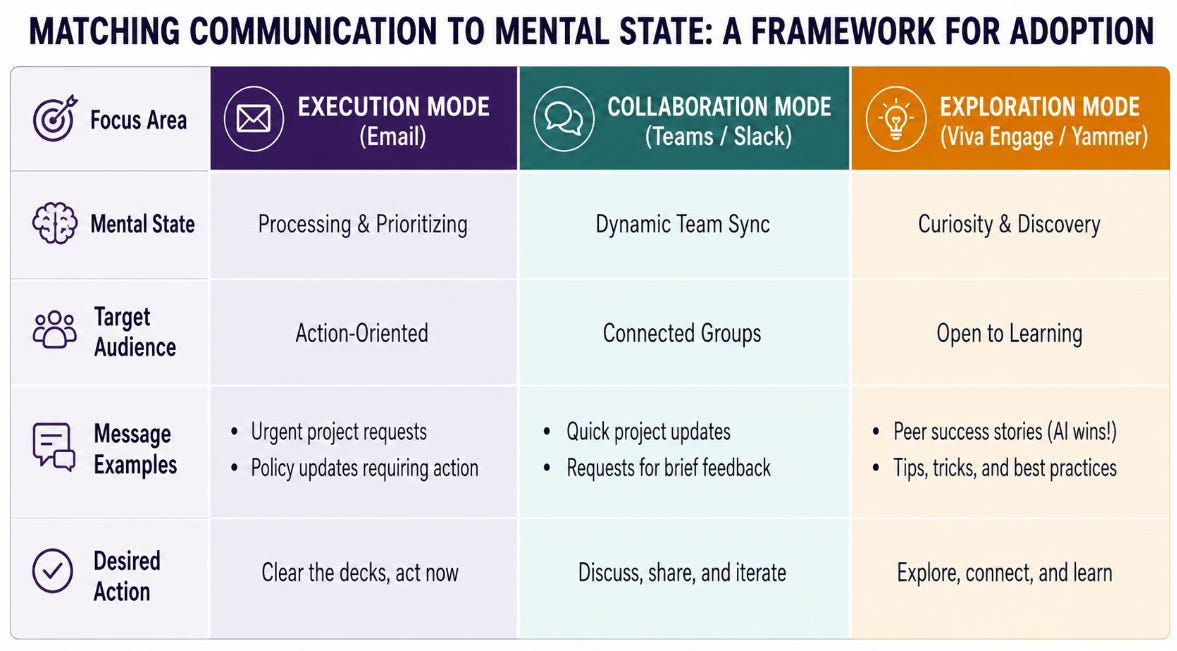
Think about how an employee moves through their day. Every channel we use carries a different “vibe” that changes how we receive information.
Email is “Execution Mode.” People open their inbox to process, prioritize, and act. They are scanning for urgency. When an AI update lands there, it competes with hard deadlines. If it doesn’t require immediate action, it gets deferred - which usually means it is gone forever.
Teams and Slack are “Collaboration Mode.” These platforms are more dynamic, but they come with a trap: constant noise. An AI channel with hundreds of members often has only a handful of active readers. When people are deep in project work, a ping about a new AI feature feels like an interruption, not an invite.
Internal Social Platforms (like Viva Engage) are “Exploration Mode.” Here, the mental state shifts. Employees are browsing. They are curious. It is the workplace equivalent of scrolling LinkedIn during a coffee break - and in that state, they are actually ready to learn. They will read a post they didn’t plan to, watch a short video, or ask a question.
This is the mindset AI adoption needs to reach.
What Leaders Often Get Wrong
The instinct, when adoption lags, is to communicate more. Send another email. Post another update.
But volume isn’t the problem. Channel fit is.
AI adoption at least in its early stages is a behavioral invitation. And invitations don’t perform well in channels built for urgency.
Organizations making real progress aren’t necessarily the ones with the most expensive tools. They are the ones that use a balanced mix: email for the big milestone moments, Teams/Slack for the engaged community, and social platforms for the ongoing, low-pressure work of shifting mindsets.
They create a place where AI content lives, grows, and accumulates so employees can visit on their own terms when they finally have a quiet moment to explore.
The Takeaway
Here is a question to sit with: When your organization sends an AI update, what state of mind do you expect your employees to be in when they receive it?
If the honest answer is “overwhelmed, moving fast, probably scanning for the delete button,” then the message is landing technically but it isn’t being heard.
The companies that win aren’t just pushing updates; they are paying attention to where their people are actually ready to listen. That isn’t a technology decision. It’s a leadership one.
Stay curious,
AI Lady 💫
About the Author
Priya Tahiliani has spent the last 15 years at the intersection of business and technology. She is a Copilot Adoption Lead with a global reinsurance company living and breathing AI adoption every single minute of her day.
In her past life she has worked as a SAP HCM and SAP SuccessFactors consultant with Big Four firms and clients worldwide.
She built and launched her company’s first AI tool by forging a great partnership with IT, and today she continues to work with leaders to help shape the future of work and drive AI enablement.
Beyond work, she serves as Vice President of Public Relations at Toastmasters. She is also the Founder of the AI Collective – Oakville Chapter in Canada, part of the world’s largest community for AI professionals - a network dedicated to learning and leading responsibly with AI.
And of course, she writes the AI Lady newsletter, where she shares her experiences, insights, and thoughts about how AI is reshaping our workplaces.
If this article sparked something for you, share it with someone else navigating this shift. These conversations matter more when we have them together.