


When we bought our home pre-construction, we had a short window to request changes before the builders locked everything in.
Suddenly, we had to make dozens of decisions all at once.
Cabinet finishes.
Appliance placements.
Floor tiles.
Where the sink should go.
Bathroom fixtures.
Tapware.
Ceramic.
It felt endless.
Because once construction starts, changing anything later becomes very expensive.
Move the kitchen sink?
Now you’re tearing out pipes.
Shift the oven?
You’re ripping up cabinets.
Change your mind about the island countertop?
That’s thousands of dollars gone.
So the logic is obvious:
Plan everything before you build.
For decades, organizations have operated exactly the same way.
The Old Economics of Building Software
In the past, building something new inside a company was expensive.
A new HR system.
A new workflow.
A new digital product.
You would need:
months of requirements gathering
long architecture documents
planning committees
Why?
Because once the build started, change was COSTLY.
Just like moving that kitchen sink.
If you discovered halfway through that the idea wasn’t quite right, fixing it meant:
rewriting code
rebuilding systems
blowing the budget
So organizations optimized for planning.
Think first. Build later.
But Something Fundamental Has Changed
AI is quietly rewriting the economics of building.
Today, teams can:
prototype tools in days (sometimes hours)
generate code with AI assistance
automate workflows quickly
experiment with internal tools without massive engineering effort
What used to take months can now take weeks.
Sometimes days.
Tools like Lovable and Claude Code have made it dramatically easier to turn ideas into working software.
I experienced this firsthand recently.
I decided to build a small app using Lovable.
My instinct was to do what we’ve all been trained to do - sit down and design everything first.
The screens. The buttons. The flows. The functionality.
Then my husband walked by, looked at what I was doing, and said:
“Why don’t you just ask Lovable to build it and see what happens?”
I hesitated.
Part of me resisted the idea.
Planning is something I genuinely enjoy. I like thinking through the screens, the buttons, the flow. It’s how I’ve always approached building things.
So letting AI do all of it felt… uncomfortable.
Almost like skipping the part I love.
But I tried it anyway.
And honestly, what it generated in minutes was better than what I had spent time planning.
The layout made sense. The buttons were exactly where they should be. The flow worked.
All I ended up changing was the color.
Two hours later, I had a working app.
If I had tried to design every detail upfront, I’m almost certain I wouldn’t have planned it that well.
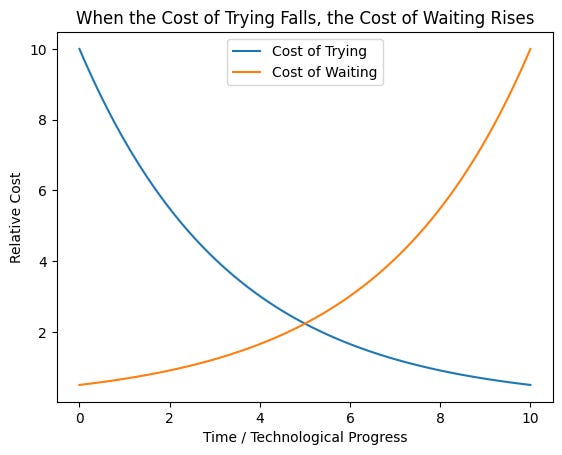
The cost of trying something has collapsed.
And when the cost of trying something drops…
The cost of waiting goes up.
The Kitchen Sink Analogy Flips
Now imagine a different world.
You decide to renovate your kitchen.
But instead of tearing down walls to move the sink, you could simply slide it across the counter in minutes.
Cabinets could be rearranged like furniture.
Appliances could be swapped instantly.
In that world, would you spend weeks planning every detail beforehand?
Probably not.
You would do something much simpler.
You would try things.
Move the sink.
Step back.
See how it feels.
Adjust.
Build a little.
Learn a little.
Adjust again.
But Most Organizations Still Behave Like the Old Kitchen:
Even as technology has changed, many management habits haven’t.
Inside companies, we still see the same patterns:
A small idea triggers a large planning process.
A simple experiment requires:
approval meetings
project charters
roadmaps
cross-functional committees
Weeks are spent debating the plan.
Very little time is spent testing the idea itself.
Ironically, the tools have made building cheaper…
…but our processes still assume building is expensive.

This Is Where Leaders Need to Adjust
The shift AI is creating is more behavioral than technological.
We have spent a lot of time planning and, at times, have failed to get projects off the ground because of overplanning.
But when the cost of change falls dramatically, the optimal strategy shifts.
The smartest organizations will no longer optimize for perfect plans.
They optimize for fast learning.
That means asking different questions.
Instead of:
“Have we fully thought this through?”
The better question becomes:
“What’s the smallest version we can test this week?”
Instead of:
“Is this the right solution?”
The better question becomes:
“What will we learn if we try it?”
Try this:
1. The “2-Hour Experiment Rule”
Before launching a full AI initiative, ask your team:
What’s the smallest version of this idea we can test in two hours?
Not two months.
Not two weeks.
Two hours.
AI tools now make it possible to prototype workflows, dashboards, copilots, and internal tools incredibly quickly.
The goal isn’t perfection.
The goal is learning faster than planning.
2. Prototype before PowerPoint.
Before writing the strategy document or scheduling the steering committee, build something small.
Even a rough prototype changes the conversation.
Instead of debating ideas, teams can react to something real.
And learning accelerates.
3. The “Kill the 30-Page Plan”
Replace the 30-page plan with three questions:
What problem are we trying to solve?
What’s the smallest version we can test this week?
What would success look like after one experiment?
If those questions are clear, the best next step usually isn’t another meeting.
It’s trying something.
This Matters More Than It Sounds
The biggest barrier to AI adoption is management habits designed for a world where change was expensive.
Approval layers.
Long planning cycles.
These made sense when every change required massive effort.
But when building becomes easier, those same processes can slow organizations down.
The friction shifts.
Not in the tools.
But in the decision-making.
A Small Shift in Mindset
There’s a quiet realization emerging across many companies right now.
The hard part is no longer building.
The hard part is deciding what’s worth trying.
In a world where change is cheap, the advantage goes to organizations that are comfortable experimenting.
Trying small things.
Learning quickly.
Adjusting often.
And perhaps that leads to a simple question for leaders:
If changing things has become easier than ever…
Why are so many organizations still planning as if it isn’t?
Stay curious.
AI Lady 💫
About the Author
I’m Priya Tahiliani, and I’ve spent the last 15 years at the intersection of People and Technology. Most of my career has focused on SAP HCM and SAP SuccessFactors consulting, working with Big Four firms and clients across the globe.
I built and launched my company’s first AI tool by forging a great partnership with IT, and today I continue to work with HR leaders to help shape the future of work and drive AI enablement.
Beyond work, I serve as Vice President of Public Relations at Toastmasters. I’m also the Founder of the AI Collective – Oakville Chapter in Canada, part of the world’s largest community for AI professionals - a network dedicated to learning and leading responsibly with AI.
And of course, I write the AI Lady newsletter, where I share my experiences, insights, and thoughts about how AI is reshaping our workplaces.
If this article sparked something for you, share it with someone else navigating this shift. These conversations matter more when we have them together.
Pass it along to a leader, an HR partner, or a curious mind who’s thinking about where AI is taking us next.
Click here to redeem your special offer!
Its only valid until this weekend :)
Every organization is different. I saw some that still plan like you described, but not every organization is like that. I think one of the reason why some do still plan is, that learning is not linear. It is more like a network. And some organizations have a lot of disciplines to learn and to connect the disciplines in order to build this network. This is not fast and this is not easy. Learning takes time.
Strong piece. I would add one step before “what will we learn if we try it?”
First state the opportunity assumption clearly. No clear assumption, no trying.
Leaders need to declare what they know, what they do not know, and how this test will reduce uncertainty enough to either earn the right to invest further or stop and reallocate resources elsewhere. In that sense, every dollar spent should answer one question: have we earned the right to keep playing in this arena or not?